

Essential woodworking tools for beginners do not need to be expensive or complicated. Starting woodworking does not require a workshop full of expensive equipment. A small, carefully chosen set of tools can handle many beginner projects, from shelves and storage boxes to simple tables and outdoor pieces.
The best approach is to buy tools according to the work you plan to do, rather than collecting everything at once. This guide explains the essential woodworking tools every beginner should consider, what each tool is used for, and which purchases can wait until later.
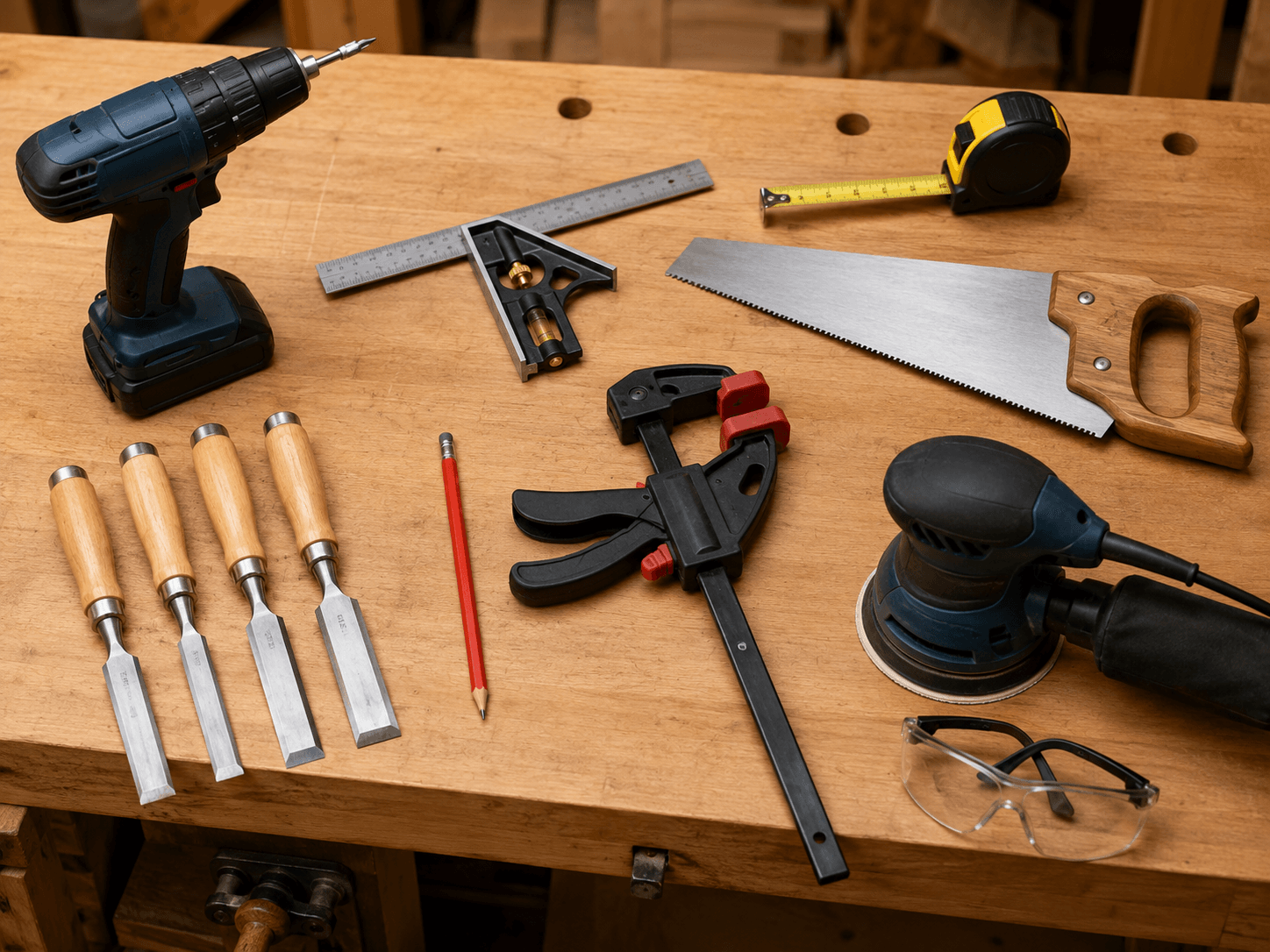
Essential Woodworking Tools for Beginners: Start With the Basics
Accurate woodworking begins before the first cut. Measuring and marking tools help you transfer dimensions, establish straight reference lines, and keep parts consistent.
Tape Measure
A dependable 16-foot or 25-foot tape measure is useful for checking board length, planning project dimensions, and measuring the space where a finished project will be placed.
Choose one with markings that are easy to read and a blade that locks securely. For most small woodworking projects, a compact 16-foot model is sufficient.
Combination Square
A combination square is one of the most useful tools in a beginner workshop. It can help you:
- Mark 90-degree lines across a board
- Check whether corners are square
- Measure short distances
- Set consistent offsets from an edge
- Check the depth of grooves or recesses
A 12-inch combination square is a practical general-purpose size. Before buying one, confirm that the head locks firmly and the ruler does not shift during use.
Marking Pencil and Utility Knife
A sharp pencil works well for general layout. A utility knife can produce a finer line when precision matters, especially when marking cuts that must fit closely.
Keep more than one pencil in the workshop. A dull or missing pencil can interrupt a project more often than expected.
Basic Hand Tools Every Beginner Should Own
Even when power tools handle most of the cutting, hand tools remain useful for adjustments, assembly, cleanup, and tasks that require more control.
Claw Hammer
A standard claw hammer is useful for driving and removing nails, adjusting joints gently, and completing general workshop tasks. A 16-ounce hammer is comfortable for most beginners.
Screwdriver Set
Choose a small set containing common Phillips and flat-head sizes. Woodworking projects often use screws for assembly, hardware installation, and temporary positioning.
A multi-bit screwdriver can save space, but separate full-size screwdrivers may provide better comfort and control.
Chisels
A small beginner set containing approximately 1/4-inch, 1/2-inch, and 3/4-inch chisels can handle many common tasks. Chisels are useful for:
- Cleaning corners and recesses
- Adjusting joints
- Removing small amounts of wood
- Trimming plugs or dowels
- Correcting areas that a saw cannot reach easily
Chisels must be kept sharp. A dull chisel requires more force and is harder to control.
Hand Saw
A general-purpose hand saw is inexpensive, quiet, and useful when only a few cuts are needed. It is also a good backup when working away from electrical outlets.
Beginners may find a Japanese-style pull saw easier to control because its thin blade cuts on the pull stroke. A traditional crosscut saw is another reliable option.

Beginner-Friendly Power Tools
Power tools make repetitive tasks faster, but beginners do not need to purchase every machine immediately. Start with versatile tools that can support several types of projects.
Cordless Drill and Driver
A cordless drill is often the most useful first power tool. It can drill pilot holes, drive screws, install hardware, and assist with sanding when fitted with certain attachments.
Look for a model with:
- Variable speed
- An adjustable clutch
- A keyless chuck
- At least one rechargeable battery
- A comfortable grip
A compact 12-volt drill may be sufficient for light projects. An 18-volt or 20-volt platform offers more power and may be better if you expect to add compatible cordless tools later.
Circular Saw
A circular saw can make straight cuts in boards and sheet materials. It is more affordable and easier to store than a table saw, making it suitable for a small beginner workshop.
For better results, use a straight board, level, or commercial edge guide as a cutting guide. Support the workpiece properly and confirm that the blade will not contact the workbench or floor beneath it.
Random-Orbit Sander
A random-orbit sander removes roughness, smooths joints, and prepares wood for paint or finish. It is faster than sanding entirely by hand and usually leaves fewer visible scratch patterns than a basic sheet sander.
A five-inch model is common and easy to find. Begin with a coarse or medium grit only when necessary, then progress through finer grits rather than trying to finish with one sanding disc.
Jigsaw
A jigsaw is useful for curved cuts, interior cutouts, and shapes that a circular saw cannot make. It is not always essential for the first project, but it becomes valuable when your designs include rounded corners or decorative profiles.
Use the correct blade for the material and avoid forcing the saw through the cut. Excessive pressure can cause the blade to wander.
Clamps Are Essential Assembly Tools
Clamps hold parts securely while glue dries, keep boards aligned during assembly, and provide an extra hand when drilling or cutting.
A practical starter collection may include:
- Two or four medium bar clamps
- Two small quick-grip clamps
- One or two spring clamps
Clamp capacity should match the size of the projects you plan to build. For small boxes, shelves, and workshop organizers, 12-inch and 24-inch clamps are useful starting sizes.
Place scrap wood between the clamp jaws and the project when necessary to prevent dents. Tighten only enough to hold the joint securely; excessive pressure can force parts out of alignment or squeeze too much glue from the joint.
Planning your first build?
Review a structured collection of beginner-friendly woodworking plans and project ideas before purchasing specialized tools.
Do Not Overlook Safety Equipment
Safety equipment should be purchased with the tools, not after an accident or close call. At minimum, a beginner workshop should include eye protection and hearing protection.
Safety Glasses
Wear safety glasses whenever cutting, drilling, sanding, hammering, or working with material that may produce chips or dust. Choose glasses that fit comfortably enough to remain on throughout the task.
Hearing Protection
Circular saws, sanders, shop vacuums, and other power tools can produce damaging noise. Earmuffs are convenient because they are easy to put on and remove. Foam earplugs are inexpensive and useful as backups.
Dust Protection
Sanding and cutting produce fine dust. A properly fitted dust mask or respirator helps reduce inhalation. Work in a ventilated area and connect dust collection or a shop vacuum when your tools support it.
First-Aid Supplies
Keep a basic first-aid kit in an easy-to-reach location. It should not be buried beneath tools or stored across the house from the workshop.
Sanding and Surface-Preparation Supplies
Good finishing begins with careful surface preparation. Even a correctly assembled project can look unfinished if the wood remains rough or covered with visible scratches.
Keep several sandpaper grits available, such as:
- 80 grit: Heavy material removal and rough surfaces
- 120 grit: General smoothing
- 180 grit: Preparing many projects for finish
- 220 grit: Light final sanding or sanding between finish coats when appropriate
A sanding block helps keep hand sanding flat and prevents fingertips from creating uneven grooves. You can buy one or make one from a small scrap of wood or firm foam.

Useful Workshop Support Items
Several inexpensive items can make woodworking safer and more organized.
Workbench or Stable Work Surface
A permanent workbench is helpful but not required at the beginning. A sturdy folding table, portable work stand, or sheet of plywood supported correctly can serve as a temporary surface.
The surface must remain stable during cutting and assembly. Do not use lightweight furniture that can shift, tip, or collapse under pressure.
Extension Cord
Use an outdoor-rated or workshop-appropriate extension cord with enough capacity for the connected tool. Inspect it regularly for damaged insulation or loose plugs.
Shop Vacuum
A shop vacuum helps control dust and keeps the floor clear of chips that may create slipping hazards. It can also connect to many sanders and saws with the correct adapter.
Storage Containers
Small bins or divided organizers keep drill bits, screws, pencils, blades, and hardware visible and accessible. Organized storage reduces wasted time and helps prevent duplicate purchases.
Tools You Can Usually Wait to Buy
Some tools are valuable but not necessary for a beginner’s first projects. Consider postponing these purchases until a specific project requires them:
- Table saw
- Miter saw
- Router and router table
- Thickness planer
- Jointer
- Drill press
- Band saw
- Large dust-collection system
Waiting gives you time to learn which types of projects you enjoy and which tools would genuinely improve your workflow. It also reduces the risk of buying equipment that remains unused.
A Budget-Conscious Starter Tool List
A practical beginner kit does not need to be purchased in one shopping trip. Build it in stages.
Stage One: Layout, Assembly, and Safety
- Tape measure
- Combination square
- Pencils
- Safety glasses
- Hearing protection
- Cordless drill
- Drill and driver bits
- Screwdriver set
- Two or four clamps
Stage Two: Cutting and Smoothing
- Circular saw or hand saw
- Straightedge guide
- Random-orbit sander
- Sandpaper in several grits
- Dust mask or respirator
Stage Three: Expand for Specific Projects
- Jigsaw for curves and cutouts
- Chisels for joinery and adjustments
- Longer clamps for larger assemblies
- Shop vacuum for improved dust control
- Specialized tools required by the next planned project
This staged approach keeps the initial cost manageable and helps ensure that each purchase has a clear purpose.
How to Choose Between Corded and Cordless Tools
Cordless tools are portable, convenient, and useful in small spaces where outlets are limited. Corded tools often provide steady power without battery charging and may cost less for comparable performance.
For a drill, cordless is usually the most convenient choice. For a sander or circular saw used mainly near a workbench, either design can work well.
When buying cordless tools, consider staying within one battery platform. Compatible batteries can reduce future costs, but only if the tools in that platform match your needs.
Buy for the Project, Not for the Workshop Image
It is easy to assume that serious woodworking requires a large collection of machines. In practice, many useful projects can be completed with a drill, a saw, a sander, basic measuring tools, and clamps.
Before purchasing a tool, ask:
- Which upcoming project requires it?
- Can a tool I already own complete the task safely?
- Can the tool be borrowed or rented?
- Do I have enough storage space?
- Will I use it more than once?
These questions help separate necessary purchases from tools that merely look appealing.
Choose your tools around a real project.
Explore these woodworking project plans for beginners to identify the tools and materials your first build will actually require.
Final Thoughts
The essential woodworking tools for a beginner are the ones that support accurate measurement, safe cutting, secure assembly, and smooth finishing. Start with a tape measure, combination square, drill, saw, sander, clamps, and proper safety equipment.
Add specialized tools only when a project creates a genuine need. A modest, organized tool collection used carefully is more valuable than an expensive workshop filled with equipment you have not learned to use.

